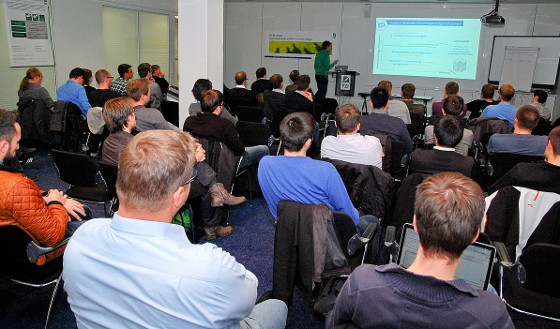
The Symposium on Software Performance: Joint Kieker/Palladio Days 2013, which took place November 27-29 (Wed-Fri), 2013 in Karlsruhe, Germany, brought together researchers and practitioners interested in all facets of software performance, ranging from modeling and prediction to monitoring and management. The symposium was organized by two already established user groups: for the first time, the Kieker and the Palladio communities had a joint meeting in form of this symposium. Kieker is a well-established tool and approach for monitoring software performance of complex, large, and distributed IT systems. Palladio is a likewise-established tool and approach for modeling software architectures of IT systems and for simulating their performance. However, contributions were not limited to these two communities but we also welcomed contributions from the field.
Reverse Engineering of Kieker
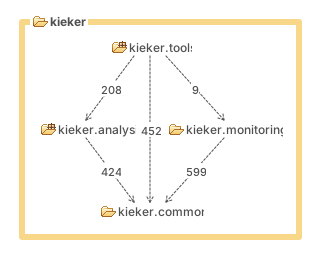
In our master project, we used STAN4j and Visual Paradigm to carry out a static analysis of Kieker 1.7 and rebuild its architecture. As shown in Figure 1, Kieker consists of four components named common, monitoring, analysis, and tools.
Continue reading
Kieker 1.8 released
Today, we released version 1.8 of our Kieker framework for application performance monitoring and dynamic software analysis: https://kieker-monitoring.net/
- New features (selection)
- Data Bridge: Facility to connect Kieker’s Java core with other platforms
- New reader plugin that provides the current system time in regular intervals
- New TCP writer and reader
- Acceleration/slow-down factor for real-time replayer
- Minor changes to the record API
- Additional method for binary (de)serialization
- `TYPES` field now public
- Many record types no longer `final` (eases custom extensions)
- Bug fixes and improvements to code, performance, tests, build scripts, documentation, examples
- Various improvements to the WebGUI (see separate `HISTORY` file)
For details and download see https://kieker-monitoring.net/
CfP/CfPart: Kieker/Palladio Days 2013
As a follow-up event of our very successful KoSSE-Symposium: Application Performance Management (Kieker Days 2012), the Symposium on Software Performance (Joint Kieker/Palladio Days 2013) will take place on November 27-29 (Wed-Fri), 2013 in Karlsruhe, Germany (FZI Forschungzentrum Informatik). It will be a joint annual meeting with the Palladio community.
Details are provided on the symposium web site: http://www.kieker-palladio-days.org/
Save the date: Joint Kieker/Palladio Days 2013
As a follow-up event of our very successful KoSSE-Symposium: Application Performance Management (Kieker Days 2012), the Symposium on Software Performance (Joint Kieker/Palladio Days 2013) will take place on November 27-29 (Wed-Fri), 2013 in Karlsruhe, Germany (FZI Forschungzentrum Informatik). It will be a joint annual meeting with the Palladio community.
Save the date! Details will follow soon.
Symposium on Software Performance (Joint Kieker/Palladio Days 2013)
November 27-29 (Wed-Fri), 2013
FZI Forschungzentrum Informatik, Karlsruhe, Germany
https://kieker-monitoring.net/kieker-palladio-days-2013/
NovaTec takes a look at Kieker
Stefan Siegl and Ivan Senic of NovaTec decided to take a close look at the Kieker Monitoring framework and published a short article on their findings:
Analysing Kieker with JBoss DVDStore sample application
[…]
Together with my collegue Ivan Senic we thought we give it a try.
[…]
We chose to use the DVD store sample application that ships with JBoss 5.1 to test Kieker.
[…]Conclusion
Kieker Monitoring is a monitoring framework that provides – out-of-the-box – offline analysis functionality for the application monitoring. We think that these features are especially useful for architecture and infrastructure detection.
[…]
Head over to the NovaTec Blog for the full article.
Kieker 1.7 released
Today, we released version 1.7 of our Kieker framework for application performance monitoring and dynamic software analysis: https://kieker-monitoring.net/
- Major changes
- Adaptive monitoring: extended set of (de)activation patterns to support adaptive monitoring for custom probes. Before: limited to (de)activate monitoring for operation signature patterns.
- New file system writers supporting (ZIP) compression
- Minor modifications to the Kieker.Analysis API:
- Removed the `register` methods. Registration now implicit by passing context information to the plugin constructors. A legacy mode for the previous API is included in this version.
- Analysis projects can now have properties available to the plugins.
- Bug fixes and improvements to code, tests, documentation, examples
- Various improvements to the WebGUI (see separate `HISTORY` file)
- Infrastructure:
- Kieker releases now also published via Maven Central Repository (http://search.maven.org/)
- Completely redesigned web site: https://kieker-monitoring.net
- Live demo at http://demo.kieker-monitoring.net
Eclipse IDE Plug-In
Kieker provides an Eclipse-Plugin for monitoring and analyzing Java projects from within the Eclipse IDE.
The monitoring part allows to instrument and run Java-projects within Eclipse.
The analysis part allows to process a Kieker log folder by a user-defined Kieker analysis.
Kieker Trace Analysis Tool with GUI
Kieker’s Trace Analysis Tool allows to reconstruct and visualize architectural representations of the monitored systems from trace information collected at runtime. Currently supported architectural representations include
- Software architectural diagrams
- Sequence diagrams
- Call trees (single traces, aggregation of trace sets)
- Dependency graphs (container-, component-, and operation-level)
- HTML output of the reconstructed system model
- Textual trace and trace equivalence representations
- Execution traces
- Message traces
Diagrams can be exported into pixel and vector graphic formats (PDF, SVG, PNG, etc.).
The TraceAnalysisTool can be used via a command line interface and a dialog-based GUI.
Kieker Trace Diagnosis
The Kieker Trace Diagnosis is a JavaFX-based GUI which allows the user to analyze and interact with recorded traces.
It reads in the desired monitoring log, analyzes it, and finally visualizes it as filterable and sortable tables and tree views.
The provided views show operation calls, such as method invocations and SQL queries, (including type name, operation name, execution time etc.) and traces both aggregated and in detail.